There's a moment every growing maker knows. You land a wholesale account. The order is bigger than anything you've filled before. You check your shelves, and the math doesn't work: you have enough shea butter for 200 units, but only enough jars for 80. The labels won't arrive until next Thursday. The fragrance oil you need is backordered for six weeks.
You scramble. You overnight supplies at triple the cost. You shift your production calendar. You stay up until 2 a.m. hand-pouring to meet the deadline. And when the order ships, you feel relief — but also exhaustion. You know this isn't sustainable. You know that somewhere between your supplier's warehouse and your studio shelves, there's a system that should be working for you instead of against you.
That system is inventory flow. And for most artisan studios, it's the silent bottleneck that strangles growth before it ever becomes visible.
The two inventories nobody talks about.
When most people think about inventory, they picture finished products on a shelf. But artisan studios carry two fundamentally different types of inventory, and they move at different speeds with different constraints:
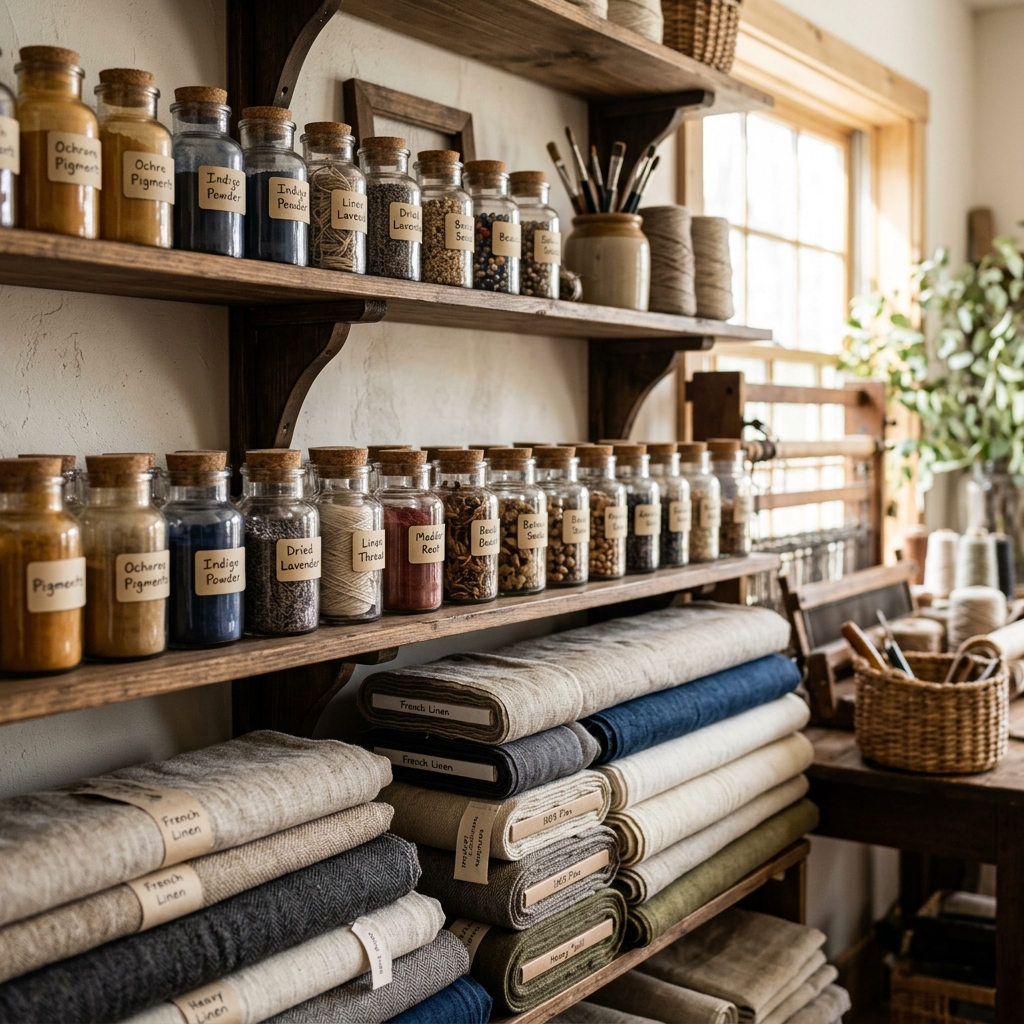
- Raw materials: The ingredients, components, packaging, and supplies that go into production. These have minimum order quantities, lead times, shelf lives, and supplier dependencies.
- Finished goods: The products that are ready to sell. These have seasonal demand curves, channel-specific requirements, and storage constraints.
The relationship between these two inventories is where most studios break. Either you're sitting on too much raw material — tying up cash in shea butter that won't be used for months — or you don't have enough when demand spikes. Either your finished goods shelves are overflowing with last season's holiday set, or you're selling out of your bestseller every other week.
"I had $3,000 in raw materials sitting in my studio and couldn't fill my top three orders. The ingredients were all wrong for what people were actually buying."
The cash flow trap.
Here's the part that doesn't show up in Instagram studio tours: inventory is where your cash goes to sleep. Every dollar sitting on a shelf as raw material or finished product is a dollar that can't pay your rent, fund your marketing, or cover the next supply order.
For a studio doing $5,000 a month in revenue, it's not uncommon to have $3,000–$4,000 locked up in inventory at any given time. That's 60–80% of monthly revenue, immobilized. And because most makers buy in bulk to get better per-unit pricing, the temptation is always to over-purchase — to buy 50 pounds of wax instead of 10, because the cost-per-pound drops by 30%.
The savings are real, but so is the risk. If that wax sits for six months, you've saved 30% on materials but lost the use of that capital for half a year. If your product line shifts, if a supplier discontinues a fragrance, if a new regulation changes your formulation — you're stuck with materials you can't use and money you can't get back.
The rhythm of production planning.
The studios that handle inventory well don't just track what they have. They plan what they'll need. And they do it with a rhythm — a cadence of ordering, producing, and replenishing that matches their actual demand patterns.
- Know your lead times: How long does each supplier take to deliver? If your jar vendor ships in 3 days but your fragrance house takes 3 weeks, your ordering schedule needs to reflect that.
- Set reorder points: For every raw material, know the minimum stock level that triggers a new purchase order. This isn't a guess — it's based on your average daily usage, your supplier's lead time, and a safety buffer.
- Batch your production: Making 50 units at a time is almost always more efficient than making 10. But making 500 when you only sell 50 a month ties up too much capital. Find the batch size that balances efficiency with cash flow.
- Track finished goods velocity: Know which products move fast and which sit. Your bestseller needs a deeper safety stock. Your seasonal items need a production ramp and a clear cutoff date.
Where MakerMind steps in.
MakerMind's inventory engine was designed for this exact challenge. It tracks both raw materials and finished goods in a single view. It knows the relationship between them — how many units of Product A you can make with the materials you currently have on hand.
When you log a production batch, MakerMind automatically decrements your raw materials and increments your finished goods. When you process a sale, it decrements your finished goods. When a material drops below its reorder point, you get a notification — not an alert buried in a spreadsheet, but a clear signal that says: "Order more 8oz amber jars. You have 4 days of stock remaining at current production rates."
This is the flow state for operations. Not the mystical creative kind — the logistical kind. The kind where materials arrive before you need them, production runs smoothly because everything is staged, and you never find yourself at 2 a.m. scrambling to fill an order you should have seen coming weeks ago.
Your craft deserves to flow. The business around it should, too.
Continue reading the dispatches
View All Dispatches